
Where Faith Stands: What the World Values Survey Reveals About Global Belief in God
Published on November 19, 2026 · 12 min read
Introduction: Belief on a Spinning Planet
You wake up. The phone glows. Before a headline or a hurried email, you might see a fragment of ancient poetry resting on your lock screen: “Be still, and know that I am God” (Psalm 46:10). This tiny moment, a pause before the rush, is not just a personal habit. It is part of a vast, quiet global tide. A new wave of data from the World Values Survey, reported by Religion Unplugged, helps us understand where belief in God stands today, not as an abstraction, but as a living reality in the hearts of billions.
The findings tell a story not of a world abandoning faith, but of faith shifting, deepening, and taking new shapes. For the everyday Christian who is trying to weave Scripture into the fabric of a frantic schedule, these numbers offer comfort, challenge, and a call to a more intentional practice. Let’s walk through what the survey reveals, grounding everything in the timeless language of the King James Version, and see how your quiet morning faithfulness connects to something much larger than yourself.
The Big Picture: A World Still Believing
The World Values Survey, one of the most comprehensive global studies of human belief, paints a picture that may surprise you. In an era often characterized by secular headlines, the report shows that a staggering percentage of the global population still affirms a belief in a higher power.

This is not a number in rapid freefall. Yes, Western Europe and some parts of North America show trends toward secular identification, but that story is local, not universal. In vast swaths of Africa, Asia, and Latin America, the reality is entirely different. Faith is not a relic; it is the baseline.
The article from Religion Unplugged emphasizes that understanding global belief requires resisting the temptation to view the experience of a few secularized Western cities as the final word. For the Christian reading this on their morning commute, it means you are not alone. Your private prayer is part of a global chorus.
Generational Notions: Are Young People Leaving God?
One of the most persistent narratives in Western media is that younger generations are abandoning organized religion en masse. The World Values Survey complicates this story significantly. While it is true that institutional affiliation is loosening in some countries, personal belief and spiritual hunger often remain potent.
The survey data hints at a shift from “belonging without believing” to “believing without belonging.” Many young people express a deep interest in spiritual matters, purpose, and transcendence, even if they don’t fill a pew every Sunday. They may phrase their search differently, calling it mindfulness, gratitude, or cosmic connection, but the contours of the ancient search for God remain visible.
The Lord speaks to this interior longing directly: “Behold, I stand at the door, and knock: if any man hear my voice, and open the door, I will come in to him, and will sup with him, and he with me” (Revelation 3:20). That door is often opened not in a cathedral, but in a quiet moment before the day begins.
The Demographic Crossroads: Christianity and a Changing World
The Religion Unplugged piece inevitably touches on the dramatic demographic projections that have captivated religious demographers for years. Data indicates that by roughly 2035, Islam will surpass Christianity as the world’s largest religion by population.
This projection is driven largely by fertility rates and the youth bulge in Muslim-majority countries. Christians, meanwhile, will hold fairly steady at around 29% of the global population. This shift prompts a crucial reflection for believers: what is the nature of our faith? Is it a cultural majority operating a political bloc, or is it a living body of humble disciples?
The Apostle Paul reminds us not to measure strength by mere numbers: “And he said unto me, My grace is sufficient for thee: for my strength is made perfect in weakness. Most gladly therefore will I rather glory in my infirmities, that the power of Christ may rest upon me” (2 Corinthians 12:9). The global church may be entering a new season of leaning on that sufficiency.
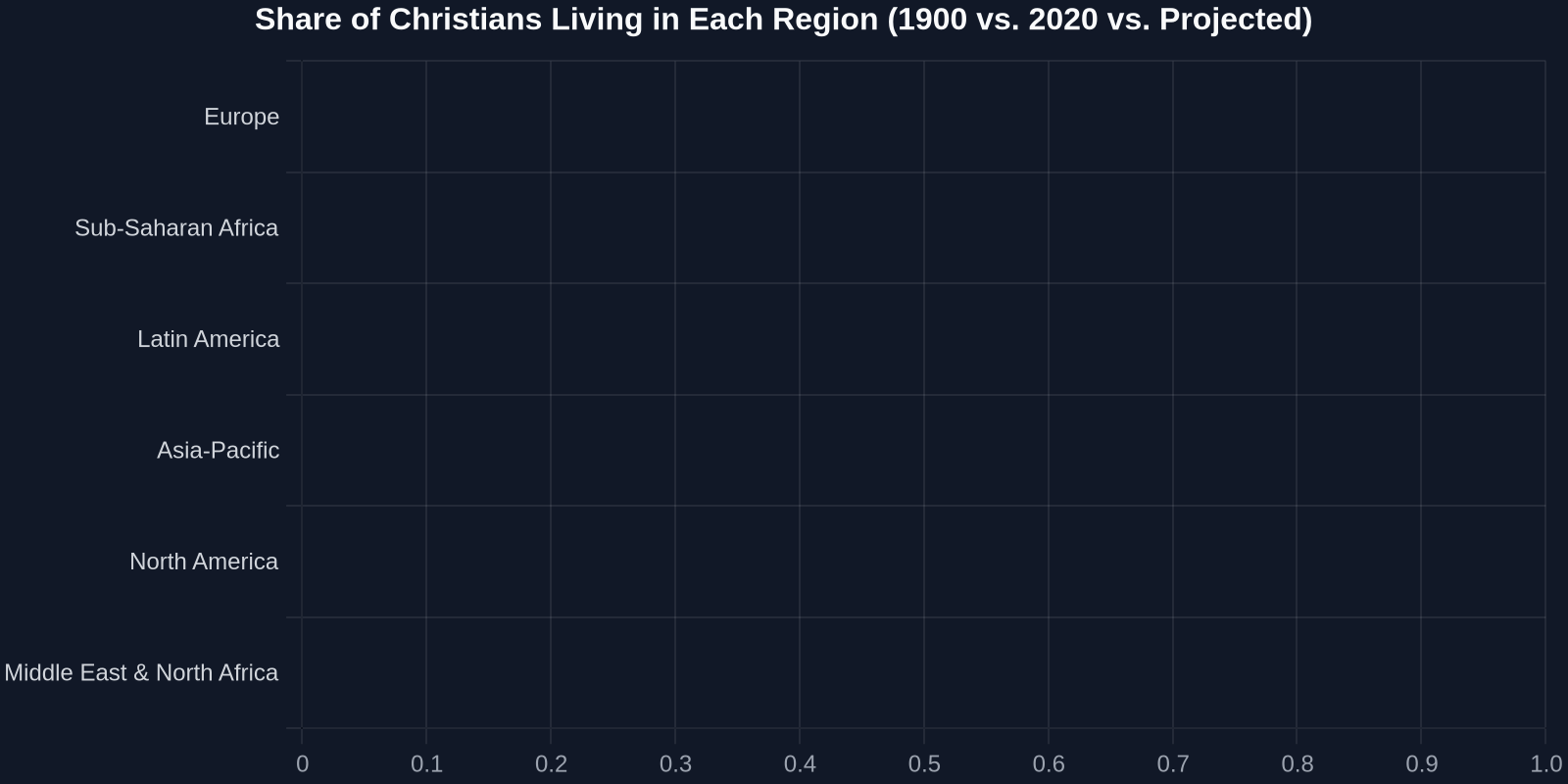
The chart above reveals that while Christianity remains concentrated in the Global South, its center of gravity is shifting dramatically out of Europe. For a Christian in London or New York, this means our brothers and sisters are statistically more likely to be in Lagos or São Paulo. This should reshape our prayer lists and our sense of family.
The Belief–Belonging–Behaving Framework
Sociologists of religion often speak of the three Bs: Believing, Belonging, and Behaving. The World Values Survey allows us to map these dimensions globally. What we see is a fracturing of the traditional unity between them.
| Dimension | Traditional Model (Mid-20th Century) | Emerging Global Model |
|---|---|---|
| Believing (Faith in God) | High, unified with church teaching | High, but increasingly eclectic and personal |
| Belonging (Church Membership) | High; lifelong denominational loyalty | Declining in the West; booming in the Global South |
| Behaving (Regular Practice) | Weekly attendance, communal rites | Daily personal habits, digital engagement, periodic communal gatherings |
This table clarifies a key point: the habit of behaving, of daily practice, is the frontier of modern faith. In a world where belonging may be fluid, the anchor becomes the small, daily choice to open Scripture. And when you do, you find Christ’s words echo across the centuries into your specific Tuesday: “I am the vine, ye are the branches: He that abideth in me, and I in him, the same bringeth forth much fruit: for without me ye can do nothing” (John 15:5). The daily abiding is the new behavior that carries the weight of belief.
The Geography of Prayer: From Private Closet to Global Connection
One fascinating dimension revealed in the World Values Survey is the geography of prayer. While attendance at formal religious services shows regional spikes and declines, the act of private, daily prayer remains astonishingly high across vastly different cultures.

This is the quiet backbone of global faith. The survey shows that even in nations where church attendance is below 10%, private prayer can remain above 40%. This suggests that the human instinct to reach out to the divine is remarkably resilient against the pressures of modernity. It also aligns perfectly with the biblical instruction to “enter into thy closet, and when thou hast shut thy door, pray to thy Father which is in secret; and thy Father which seeth in secret shall reward thee openly” (Matthew 6:6).
Prayer is the thread that holds the tapestry of belief together. And the data shows that thread is surprisingly strong. For the everyday Christian, this validates the gut feeling that God meets you on the subway just as much as in the sanctuary.
Secularization: A Regional Tide, Not a Global Flood
It cannot be denied that parts of the world are secularizing rapidly. The World Values Survey maps this meticulously, showing that in the “WEIRD” countries (Western, Educated, Industrialized, Rich, and Democratic), the percentage of those claiming “no religious affiliation” is climbing steadily. But the survey’s most important contribution is showing that this is not the destiny of the planet, but a cultural particularity.
When we place the Western European data alongside that of Sub-Saharan Africa or Southeast Asia, the lines move in opposite directions. Western Europe’s low belief is anomalous in global terms, not normative. The media often mistakes Los Angeles and London for the world. The World Values Survey corrects this myopia.
This matters for personal faith because it frees you from a narrative of inevitable defeat. There is no historical law that forces a society to abandon God once it builds a few skyscrapers. Many highly modernized Asian societies maintain robust religious practice and belief. Your faith is not a pre-modern relic to be outgrown; it is a conscious choice of the soul, relevant to any technological age.
The Vesper of Daily Practice: Anchoring in an Age of Noise
If the World Values Survey tells us anything, it is that institutional belonging is becoming less reliable for forming belief, and daily personal behavior is becoming everything. The future of faith rests less on the spectacular event and more on the unseen habit.
This is the ancient wisdom of the psalmist: “Thy word is a lamp unto my feet, and a light unto my path” (Psalm 119:105). This isn’t a floodlight that reveals the next decade. It’s a small lamp that shows the next step. The World Values Survey hints that the Christians who thrive in the coming shifts will be those who master the art of the next step.
Building a small, unbreakable rhythm of Scripture is a way to cultivate what the demographics demand: a faith that is deeply interiorized and personally owned. When the culture no longer carries the language, you must carry it in your own heart. This is easier than it sounds. It doesn’t require a block of time you don’t have. It requires a single, still moment before the screen takes over your consciousness. A moment where God’s word is literally the first thing you see.
The Economics of Time: Why a Single Verse Matters
Modern economics tells us that scarcity creates value. Time is our most scarce resource. A full chapter of the Book of Numbers before coffee? Unlikely to stick. But a single, luminous verse placed gently in your day’s path? That fits the economics of your life.
The World Values Survey doesn’t ask about widget usage, but it highlights the centrality of daily spiritual experience over weekly ritual. The trend is toward micro-liturgies, small, repeated acts of devotion woven through the day. A verse from Romans on your home screen is a micro-liturgy. It sanctifies the threshold between you and the digital world.
This statistic, while not from the World Values Survey itself, is consistent with the pattern of its findings about practice. Consistency triumphs over intensity. The small, faithful act is the vessel that carries the divine presence into your mundane tasks. As the KJV puts it, “It is the spirit that quickeneth; the flesh profiteth nothing: the words that I speak unto you, they are spirit, and they are life” (John 6:63). That spirit animates a phone screen just as it does a parchment.
From Information to Transformation: The Danger of Survey Entertainment
A final, pastoral reflection on the survey itself. It is easy to read these statistics as a form of entertainment: “Interesting, the world is getting more religious here, less there. Good to know.” Then you scroll on to the next piece of news. This turns even the sacred data of global faith into a consumer product.
The biblical response to knowledge about God’s work in the world is not curiosity; it is participation. Data about global belief is an invitation to global prayer. It is a call to see your own small faithfulness as part of a living, breathing Body of Christ that stretches from Beijing to Buenos Aires.
“And I, if I be lifted up from the earth, will draw all men unto me.”, John 12:32
Demographers predict and project. God draws. And the primary way God draws people today, in countries growing in faith and in countries forgetting it, is through the radical, lived-out alternative of Christians who abide in their vine. The World Values Survey gives us a map. The Word of God gives us a mission. And that mission starts tomorrow morning, when you pick up your phone.
One simple tool that helps some believers do this is Vesper, an iOS widget that places a single KJV verse on your lock screen each day. It serves the quiet, global trend the survey reveals: the move toward a daily, personal, and anchored spirituality in a fragmented world.
Conclusion: The Secret Place in a Statistical Age
Surveys map the surface of things. They count heads and track trends. But behind every percentage point is a soul, and behind every soul is a story of meeting God or turning away. The World Values Survey, for all its data, cannot weigh the worth of one soul: “For what shall it profit a man, if he shall gain the whole world, and lose his own soul?” (Mark 8:36).
Your walk with God is not a data point. It is a living relationship. This week, consider one small habit: before you read any news, any email, any text message, let the first words your eyes consume be from the Book that has outlasted every empire and every survey cycle. Let the global trend of daily prayer find a home in your pocket.
In the quiet, before the algorithm makes its demands, stand still and know.