
Sacred Art in Small Places: How Edward T. Grigware’s Faith Still Speaks Through a Cody, Wyoming Chapel
Published on November 9, 2026 · 17 min read

We often expect masterpieces to live behind velvet ropes in famous museums, or maybe inside towering cathedrals that draw millions of pilgrims each year. But sometimes, the most enduring works of faith are tucked into the fabric of everyday life, hanging in a hallway you pass each Sunday, or gracing the wall of a chapel where the faithful gather to sing hymns and break bread. In Cody, Wyoming, a surprising artistic treasure has reminded a congregation, and the wider world, that sacred art doesn’t need a grand stage. It just needs a willing heart, a blank wall, and a story worth telling.
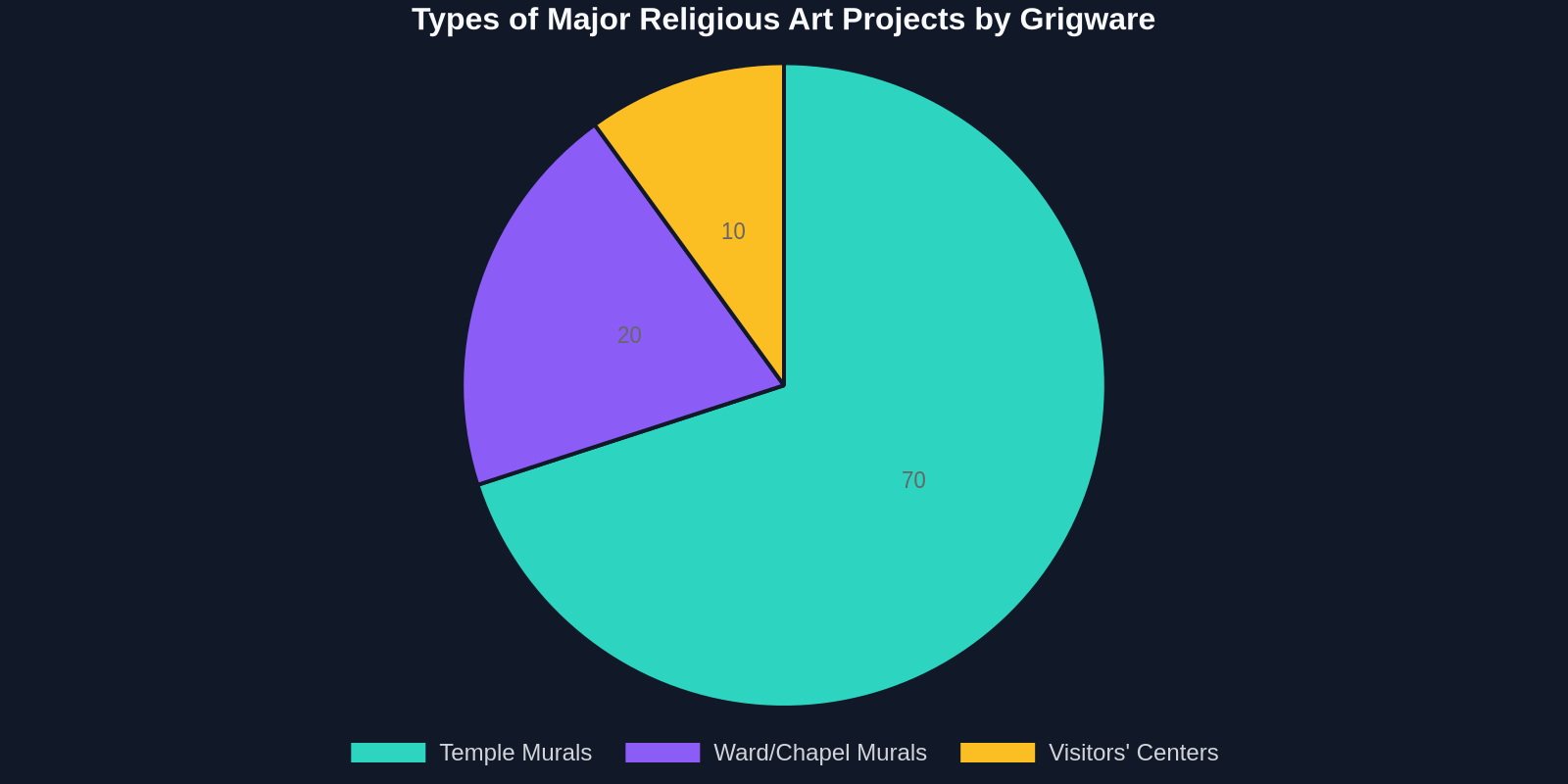
Recently, a nearly forgotten mural painted by Edward T. Grigware was rediscovered in a historic meetinghouse of The Church of Jesus Christ of Latter-day Saints. Grigware, best known for the magnificent murals that wrap the interior of the Cardston Alberta Temple and the rotunda of the Church History Museum in Salt Lake City, also left a quieter mark: a piece created for a simple ward building. The finding is a gentle reminder that our daily spaces, the places where we pray, teach, and fellowship, can contain glimpses of heaven. Even more, it’s a reminder that each believer, no matter how ordinary their circumstances, can offer their gifts to glorify God.
The story invites us to consider what we build with our own hands, and how the beauty we create in service to the Lord might outlast us, speaking truth to generations we will never meet. As it is written, “And let the beauty of the Lord our God be upon us: and establish thou the work of our hands upon us; yea, the work of our hands establish thou it” (Psalm 90:17, KJV).
A Life Painted for the Lord: Who Was Edward T. Grigware?
To understand why finding a mural in a local chapel stirs the soul, you need to understand the man behind the brush. Edward T. Grigware was not a celebrity artist chasing galleries in New York or Paris. He was a convert to the faith, a devoted Latter-day Saint, and a craftsman who saw his talent as a direct offering to God. Born in 1889, he studied at the Chicago Academy of Fine Arts and later served in the Navy during World War I. His life changed dramatically when he encountered missionaries in Hawaii and joined the Church in 1926 at the age of 37.
Unlike some artists who separate their sacred commissions from their personal passions, Grigware’s entire career became an act of worship. He didn’t simply paint religious scenes; he painted the unfolding story of salvation, often focusing on the life of Christ and the restoration of the gospel. His magnum opus is undoubtedly the Cardston Alberta Temple, where he spent years covering the interior walls with vivid depictions of the Savior’s ministry and latter-day events. Those who have sat in the stillness of that temple often describe feeling enveloped not just by the paint, but by the palpable spirit of the artist’s testimony.
Grigware also painted murals for the Los Angeles Temple, the Idaho Falls Temple, and the visitors’ center in Independence, Missouri. Yet, his life wasn’t one of detached fame. He was known to be a humble, humorous, and deeply spiritual man who saw the face of the divine in every subject he painted. For him, painting the story of the resurrected Christ appearing to the Nephites was just as holy a task as painting a pioneer scene for a school. “Whatsoever thy hand findeth to do, do it with thy might,” Solomon wrote (Ecclesiastes 9:10, KJV), and Grigware lived that out until his passing in 1960.
The Forgotten Treasure of the Cody Ward
Many travelers pass through Cody, Wyoming, drawn by the rugged beauty of the Shoshone River and the legend of Buffalo Bill. Few would think to look for a world-class mural inside a local church building. But it was there all along, a piece called the Moreablo">Rotunda mural, quietly occupying a wall, witnessing decades of potlucks, Sunday sermons, wedding receptions, and quiet prayers.

The history of the Cody building itself is a testament to faithful grit. The original chapel was built by hardy pioneers and working-class saints who didn't have the means to hire the celebrated artists of the day. However, over time, as renovations were made (particularly in the 1950s), the ward members sought to beautify their house of worship. Somehow, this local request reached Edward T. Grigware. It’s a beautiful mismatch: a renowned artist whose works hang in sacred temples agreeing to create something for a rural congregation hours away from any major city.
The mural is a classic Grigware composition, narrative, warm in tone, and deeply reverent. It depicts the resurrected Christ with outstretched arms, a theme Grigware returned to again and again. The Savior isn't depicted as a distant judge or an ethereal ghost, but as a living, present Lord, whose hands still bear the marks of His love. The striking element of this discovery is that it had fallen out of institutional memory. It took researchers combing through archives and manuscripts, cross-referencing Grigware’s lesser-known works, to realize that the mural wasn’t just a local decoration; it was a genuine, priceless gift from one of the faith’s most important artists.
Why Beauty Matters in Our Spiritual Geography
We live in an age of stark functionality. Renting a school gymnasium for Sunday services or streaming church from a laptop screen has become normalized. There is nothing inherently wrong with pragmatism. After all, the early Christians met in catacombs and upper rooms. But the rediscovery of the Grigware mural raises a gentle question: what role does beauty play in our worship? Is making a space beautiful a luxury, or a theological necessity?
Scripture suggests the latter. When the Lord instructed the building of the tabernacle in the wilderness, He didn’t just give a blueprint for structural utility. He filled Bezaleel and Aholiab “with the spirit of God, in wisdom, in understanding, and in knowledge, and in all manner of workmanship” to devise artistic works in gold, silver, and brass, and in cutting stones and carving timber (Exodus 31:3-5, KJV). The Lord cared about the aesthetics because the space was to be a “sanctuary,” a window into a higher reality.
Edward T. Grigware understood that sight leads to insight. An image of the Savior is more than decoration; it is a teaching tool. For a child sitting in sacrament meeting, bored and fidgety, looking up at the arms of the Lord spread wide can plant a seed far deeper than a spoken lesson can reach. For a grieving widow, the silent gaze of a painted Christ can comfort without uttering a single word. “He hath made every thing beautiful in his time,” the Preacher tells us (Ecclesiastes 3:11, KJV), and in the context of a community of believers, that beauty binds hearts together.
The Artisan’s Process: Mixing Pigments with Purpose
How did Grigware work? Those who study his technique note his formal academic training, but also his intuitive sense of narrative. He rarely just painted a portrait; he told a story. His handling of robes, light, and facial expressions wasn't merely about achieving realism. It was about conveying glory. The paint had to carry weight and fluidity at the same time. In the Cody mural, you see the typical Grigware signature: a strong, central figure of Christ, often illuminated by a soft, unseen source of light that suggests His divinity rather than a physical sun.
The pigments used in a mural intended for a public space had to be durable. But they also had to be mixed on a palette that included prayer. This isn't romantic hyperbole. Grigware’s contemporaries often told stories of how he would step back from a ladder, study his work, and hum a hymn. Creation for him was a spiritual rhythm. The brush was a conduit.
For modern Christian artists, or anyone creating with their hands, this is a powerful model. Whether you are painting a mural, writing a newsletter, baking a casserole for a neighbor, or balancing a spreadsheet for a ministry, the process is sacred when done with love. Grigware didn’t distinguish between the “big” Temple jobs and the “small” Ward jobs. He poured his mastery into both. As Paul wrote, “And whatsoever ye do, do it heartily, as to the Lord, and not unto men” (Colossians 3:23, KJV).
“And behold, I have filled him with the spirit of God, in wisdom, and in understanding, and in knowledge, and in all manner of workmanship.”, Exodus 31:3, KJV
Preserving a Legacy of Light
The discovery of the mural is just the beginning. Now comes the delicate work of preservation. Murals of this age face threats from humidity, temperature fluctuations, dust, and the general wear and tear of a building that is still very much alive. A temple can be a controlled environment; a local ward building is a place where children run, tables are moved, and life happens in all its beautiful chaos.
Church historians and architectural conservators are now tasked with assessing the mural's condition. What makes this project special is its context. They aren't restoring a monument for tourists. They are stewarding a piece of sacred art for a congregation that uses the room. The goal is not to turn the chapel into a museum, but to ensure that the next generation of worshippers in Cody can still see the image of their Savior clearly.
This is a metaphor for our personal faith. The image of Christ is imprinted on our hearts, but the elements of the world, stress, sin, neglect, cynicism, can obscure the picture. Repentance and daily devotion are the conservator’s tools, clearing away the grime so the original beauty shines through again. “Create in me a clean heart, O God; and renew a right spirit within me” (Psalm 51:10, KJV). Just as the mural needs gentle cleaning, our souls need the constant renewal of the Spirit.
How Local Church Art Shapes Our Discipleship
Let’s step back from the art history for a moment and focus on the human side. In the New Testament, we read about a woman who anointed the feet of Jesus with expensive spikenard. The disciples, pragmatic to a fault, complained about the waste. “Why was this waste of the ointment made?” they asked (Mark 14:4, KJV). But Jesus defended her extravagant act of beauty. She had done what she could.

Placing a high-quality mural in a rural chapel is an echo of this extravagance. It’s saying God deserves our best, not just our leftovers. It is a rebuke to the idea that “good enough” is sufficient for the Lord. When a child grows up seeing a masterpiece every Sunday, their baseline for what is holy and beautiful shifts upward. They learn that faith is not ugly, mediocre, or boring. It is glorious.
The Cody mural isn't a one-of-a-kind phenomenon, though it is uniquely valuable. Across the world, in small chapels and humble meetinghouses, artists have left their marks. Stained glass windows in country churches, hand-carved podiums, embroidered altar cloths, these are the treasures in jars of clay. They point not to the artist, but to the Artist. “For we are his workmanship, created in Christ Jesus unto good works” (Ephesians 2:10, KJV).
The Intersection of Art and Testimony
A critic might look at Grigware’s work and analyze the composition, the use of perspective, or the historical accuracy of the robes. That’s one way to see. But a believer, sitting in a pew during a quiet moment before services, sees something else entirely. They see a testimony. Grigware believed in the literal resurrection of Jesus Christ, and he used his canvas to proclaim that belief. He didn't just paint a symbolic myth; he painted a historical fact that shapes eternity.
This is the highest calling of Christian art. It is not about the artist’s ego, but about the subject’s glory. Non-religious art often seeks to deconstruct or provoke. Sacred art seeks to edify and invite the Holy Spirit. When Grigware painted the muscular arms of Jesus pulling Peter from the water, or showing His wounds to Thomas, he was preaching silently but powerfully. He was telling the skeptics and the weary, “Look and live.”
Art invites us to use our spiritual imagination. When we read in the Gospels of Christ standing on the shores of Galilee, we see it through a glass darkly. A painting like the one in Cody gives our minds a place to land. It helps us picture the unimaginable: the King of Kings in a body of flesh and bone, standing before us, ready to embrace us. It aligns with the Psalmist’s invitation: “Taste and see that the Lord is good” (Psalm 34:8, KJV).

Rediscovering the Sacred in the Ordinary
The narrative of the lost and found mural resonates deeply because we all fear being forgotten. The saints in Cody didn’t make a national announcement when the mural was finished. They simply looked at it, worshipped under it, and eventually, the generation who commissioned it passed away. The knowledge of its specific provenance faded. But the mural remained faithful to its purpose. It kept reflecting light. It kept showing Christ. It kept serving exactly as intended, even when its creator’s name was temporarily lost to local memory.
Isn’t that the dream of every believer? To be faithfully serving, to be a conduit of grace, even if no one knows our name? John the Baptist articulated it perfectly when he spoke of the Lord: “He must increase, but I must decrease” (John 3:30, KJV). Grigware’s name is on the historical records, but his brushstrokes point entirely to the Messiah. The mural is a lasting testament to decreasing the self so that the Son can increase in the eyes of the beholder.
The rediscovery also highlights the value of spiritual archaeology. Sometimes we think we need to build something new to inspire faith. But often, we just need to clean the dust off the old paths. In our personal lives, what gifts have we neglected? What talents did we bury because they seemed too humble to be used? The Cody mural encourages us to revisit the “archive” of our own life and ask if there’s a forgotten offering we can still give to God.
Learning from the Giglio Grigware: Faith Notes Silently
Perhaps the most poetic aspect of this story is the silence. The mural makes no sound. It doesn't argue on social media. It doesn't defend its theology in a comment section. It simply hangs there, a fixed point in a spinning world, declaring, “He is risen.” As our world gets louder, the quiet witness of sacred art becomes increasingly vital. It is a counterbalance to the algorithm. It feeds the part of the soul that needs stillness to know God. “Be still, and know that I am God” (Psalm 46:10, KJV).
Edward T. Grigware’s life and the mural in Cody teach us that the most profound statements of faith are often made quietly. They stand as silent sentinels of testimony, bridging the gap between a 20th-century painter and a 21st-century smartphone user who, walking in, looks up and momentarily forgets their worries.
The Unseen Restoration: A Metaphor for the Soul
As the physical restoration of the Cody mural proceeds, the process will be meticulous. Conservators will test solvents gently, remove decades of lacquer yellowing, and stabilize flaking pigment. They cannot paint over Grigware’s original strokes. They can only reveal them. This is a perfect picture of sanctification. The Holy Spirit doesn't paint a new personality over our old one; He restores the original image of God within us, stripping away the debris of sin to reveal the masterpiece that was always intended.
Sometimes believers live in frustration, thinking God wants to make them into someone completely unrecognizable. But the Creator who made us knows our frame. His goal is to bring us back to our truest selves, the selves we were designed to be before the world marred the canvas. “For I am the Lord, I change not” (Malachi 3:6, KJV), and because He doesn't waver, He can make our beauty secure in His image.
“He hath made every thing beautiful in his time.”, Ecclesiastes 3:11, KJV

What You Can Build Where You Are
Not everyone can create a mural. But the story of this hidden masterpiece invites us to ask a practical question: what “work of our hands” can we establish for the Lord where we are? Your creation might be a well-tended garden, welcoming a stressed neighbor into a patch of Eden. It might be a playlist of hymns you share with a struggling friend. It might be the careful way you prepare a lesson, not for acclaim, but because the Word deserves your best effort.
The danger of reading about grand art is feeling that our daily efforts are insignificant. But the anonymity of the Cody mural speaks directly against that. Grigware painted it for a small group of saints. Was it a waste? No. It was a seed. And seeds that fall into the ground in faith bear fruit over decades. Don’t measure your spiritual legacy by the number of eyeballs you attract, but by the devotion of your offering. The smallest act, if it points to Christ, has eternal weight.
A practical habit might be to look at your own home. Is there an image or a verse on the wall that rains grace upon your family? Perhaps it’s time to create a “sacred space” in your house, a corner where the beauty of the Lord rests visibly. As for starting your day with that visual scripture, Vesper offers a simple way to see a daily King James Version verse right on your Lock Screen, setting your eyes on beauty before the noise of the world rushes in.
Conclusion: Gaze a Little Higher
The world is full of half-empty auditoriums and sterile white walls. But tucked away in a corner of Wyoming, a mural painted by a faithful servant still whispers the resurrection. It does not worry about algorithms or trends. It just stands, a solid testament to a living Christ. Edward T. Grigware left a mark that cannot be deleted by time, and the saints in Cody are the grateful custodians of that light.
As you walk through your week, passing through the “rotundas” of your own ordinary routines, the kitchen, the office cubicle, the driver’s seat, remember that the curtain between the secular and the sacred is thinner than we think. You carry the brush; the Lord provides the Masterpiece. Lay your strokes down with love, and maybe, in seventy years, someone will stumble upon the beauty you left behind and, looking at it, will see the face of Jesus.
| Principle | Secular Approach | Sacred Approach (Grigware's Model) |
|---|---|---|
| Source of Inspiration | Ego, market trends | Testimony, Scripture |
| Intended Audience | Mass market, critics | Local congregation, God |
| Measure of Success | Fame, financial return | Spiritual edification, faithfulness |
| Longevity Concern | Decades of fame | Generations of silent witness |
| Mistakes | Scratched canvas, failed showing | Forgiven, painted over by grace |
Let the work of our hands be established. And let us take a moment this Sunday, wherever we worship, to look at the walls around us. The windows, the wood, the old paintings, they are letters from the past, urging us to live beautifully for the Lord who is, and was, and is to come.