
How Kenyan Churches Are Meeting the Silent Crisis: Supporting Older Men Facing Abandonment and Suicide
Published on October 11, 2026 · 12 min read

In a small rural church outside Kisumu, an elderly widower named Joseph sits quietly in the last pew. His children rarely visit; his phone hasn't rung in weeks. A year ago, the thought of ending his life crept into his daily prayers. Today, he is alive, because a deacon knocked on his door, because a band of older men started meeting for tea and Scripture every Tuesday, because the church chose to see him.
This scene, captured in a Christianity Today report, is being repeated in villages and towns across Kenya. As the nation's social fabric frays under economic pressure and urban migration, a quiet but devastating crisis has emerged: older men are being abandoned by families and communities, and many are choosing to end their lives. Kenyan churches are stepping into the gap, offering a model of compassionate, practical care that believers everywhere can learn from.
The Hidden Crisis: Why Older Men Are Suffering in Silence
Across Africa, aging has long been understood as a season of honor, a time when the community gathers around its elders, drawing on their wisdom and repaying a lifetime of sacrifice. But rapid urbanization, the breakdown of the extended family, and the erosion of cultural norms have left many older Kenyans isolated. The problem is especially acute for men. While women often retain social networks through church, market, and caregiving roles, older men frequently withdraw, growing silent and unseen. When their physical strength fades, their sense of purpose often vanishes with it.
This statistic, drawn from World Health Organization data, points to a worldwide pattern that is far more deadly than many realize. In Kenya, the story is compounded by specific pressures: adult children moving to cities for work, leaving parents to manage homesteads alone; the lingering stigma around mental health; and a culture that often expects men to shoulder suffering without complaint. A pastor in Siaya County told Christianity Today that when older men stop coming to church, few ask why. They simply vanish, until a funeral reveals the truth.
Loneliness is not a soft emotion; it is a physiological assault. Research from the National Academies of Sciences, Engineering, and Medicine shows that social isolation significantly increases the risk of premature death from all causes. For older men, the combination of retirement, widowhood, and physical decline often severs their last ties to a meaningful daily rhythm. Without intentional intervention, the drift toward despair accelerates.
What the Bible Says About the Aged and Forgotten
Scripture repeatedly commands God's people to honor and care for the elderly. The command is not a gentle suggestion but a sacred obligation woven into the character of the community of faith. In a world that discards, the church is called to gather.

"Thou shalt rise up before the hoary head, and honour the face of the old man, and fear thy God: I am the LORD." , Leviticus 19:32 (KJV)
This verse, set in the holiness code of Israel, links reverence for the aged directly to the fear of God. To look away from an older person in need is not just a social failure but a spiritual one. The New Testament makes this even more practical. The apostle Paul, writing to Timothy, instructs believers to care for their own households, especially widows, and adds: "But if any widow have children or nephews, let them learn first to shew piety at home, and to requite their parents: for that is good and acceptable before God" (1 Timothy 5:4). The same principle extends to the entire faith family when biological family is absent. The church becomes the household of God, and every older man in it is a father to be honored, not a burden to be managed.
James, the half-brother of Jesus, defines pure and undefiled religion in part as caring for "the fatherless and widows in their affliction" (James 1:27). In the ancient world, widows were the vulnerable par excellence because they lacked a male protector. Today, we might add the abandoned older man, bereft of the honor and community that once sustained him. The church that only cares for the young and productive has missed a foundational piece of the gospel's call.
The Bible does not separate spiritual health from practical care. When Jesus tells the parable of the Good Samaritan, He is answering the question, "Who is my neighbour?" The man left half-dead on the road was not a sinner needing a sermon; he needed a hand. Older men in crisis need both the presence of Christ and a cup of cold water in His name.
What Kenyan Churches Are Doing Differently
The Christianity Today report highlights several tangible ways Kenyan congregations are moving beyond sympathy into action. These are not grand programs requiring massive funding; they are small, human-scale responses that any community can adapt.
1. Elders Visiting Elders
In many Kenyan churches, a team of older men now systematically visits every man over 60 in the congregation, and many outside it, at least once a month. They don't go with an agenda or a clipboard. They sit, they listen, they pray. Often, the most powerful moment is simply showing up. One visiting elder said, "When I knock on a door and a man says, 'I didn't think anyone remembered I existed,' I know the church has already missed something. But I also know that today, we can begin again."
2. Purposeful Small Groups
Churches have begun forming groups specifically for older men, meeting on weekday mornings when loneliness bites hardest. These gatherings often blend Bible study with practical work, repairing a widow's roof, tending a shared vegetable garden, or writing letters to grandchildren. The goal is not to entertain but to reconnect men with a sense of purpose. A pastor in Nairobi described a group that started with three members; within a year, it grew to forty, and the men began a savings circle that helps cover medical expenses. Purpose and community are the twin medicines for despair.
3. Reclaiming the Role of Elder in Worship
Several congregations have intentionally restored older men to visible roles in the Sunday service, not as a token gesture, but as a genuine restoration of dignity. Men who once felt invisible are now reading Scripture, leading prayers, and sharing testimonies. When a 75-year-old man stands before the congregation and recounts God's faithfulness over six decades, the church sees a father, not a has-been. This simple liturgical shift has had a profound effect on how the whole community views its older members.
If your church doesn't have a specific ministry to older men, ask your pastor if you can start with one coffee hour a month. Begin with the men you already know are alone. The barrier is not always money; it's the willingness to see the need and take the first small step.
4. Tackling Mental Health Head-On
Suicide prevention requires more than prayer alone, though prayer is central. Kenyan churches are partnering with Christian counselors to train lay leaders in basic mental health first aid. They are learning to recognize the signs of depression, to ask the hard question ("Have you thought about ending your life?"), and to walk with someone through crisis without shame. One counselor, quoted in the report, said, "We tell the brethren: you don't need a degree to care. You need courage and compassion."
This table reveals a stark contrast in values. The world's metrics of worth are tied to output; the kingdom of God assigns worth based on identity as an image-bearer. For the older man who has internalized society's message that he is no longer useful, the church must speak a better word: God is not finished with you.
The Deeper Roots: Culture, Economics, and the Gospel
Why are older men so vulnerable in Kenya? While urban migration is a global phenomenon, the report points to a particular cultural dynamic: in many communities, a man's identity is wrapped up in his role as provider. When age or illness strips that role away, he loses not just an income but a reason to live. The traditional support systems that once caught him are themselves eroding. The church, then, is not just a humanitarian agency; it is called to offer a counter-narrative about what makes a life valuable.

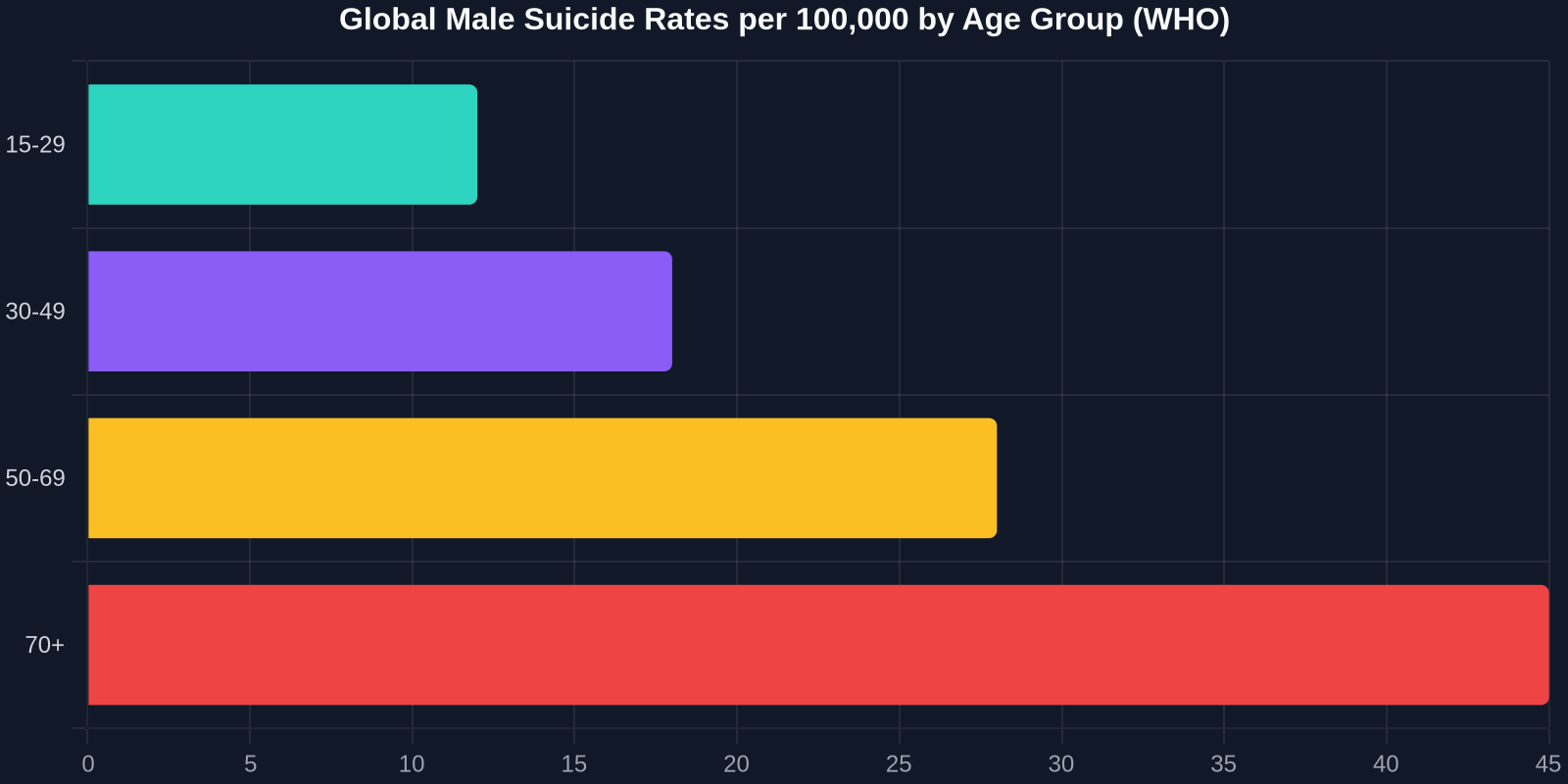
This chart, using WHO global data, illustrates a reality that holds true in Kenya as well: suicide rates climb sharply with age for men. The 70-and-over bracket faces a risk nearly four times that of the youngest adult cohort. This is not primarily a pathology of the individual but a failure of community. When a society isolates its elders, death too often follows, not as an act of despair alone, but as a final surrender to the belief that no one cares.
Yet even in this grim picture, hope is breaking through. When the church steps up, the statistics can flip. Congregations that have implemented consistent visitation and small-group support anecdotally report fewer crisis calls and a palpable change in the emotional climate of their older members. A pastor in western Kenya told Christianity Today, "I used to bury a man by suicide every few months. Since we started the men's fellowship, we have had no suicides in two years. Not one."
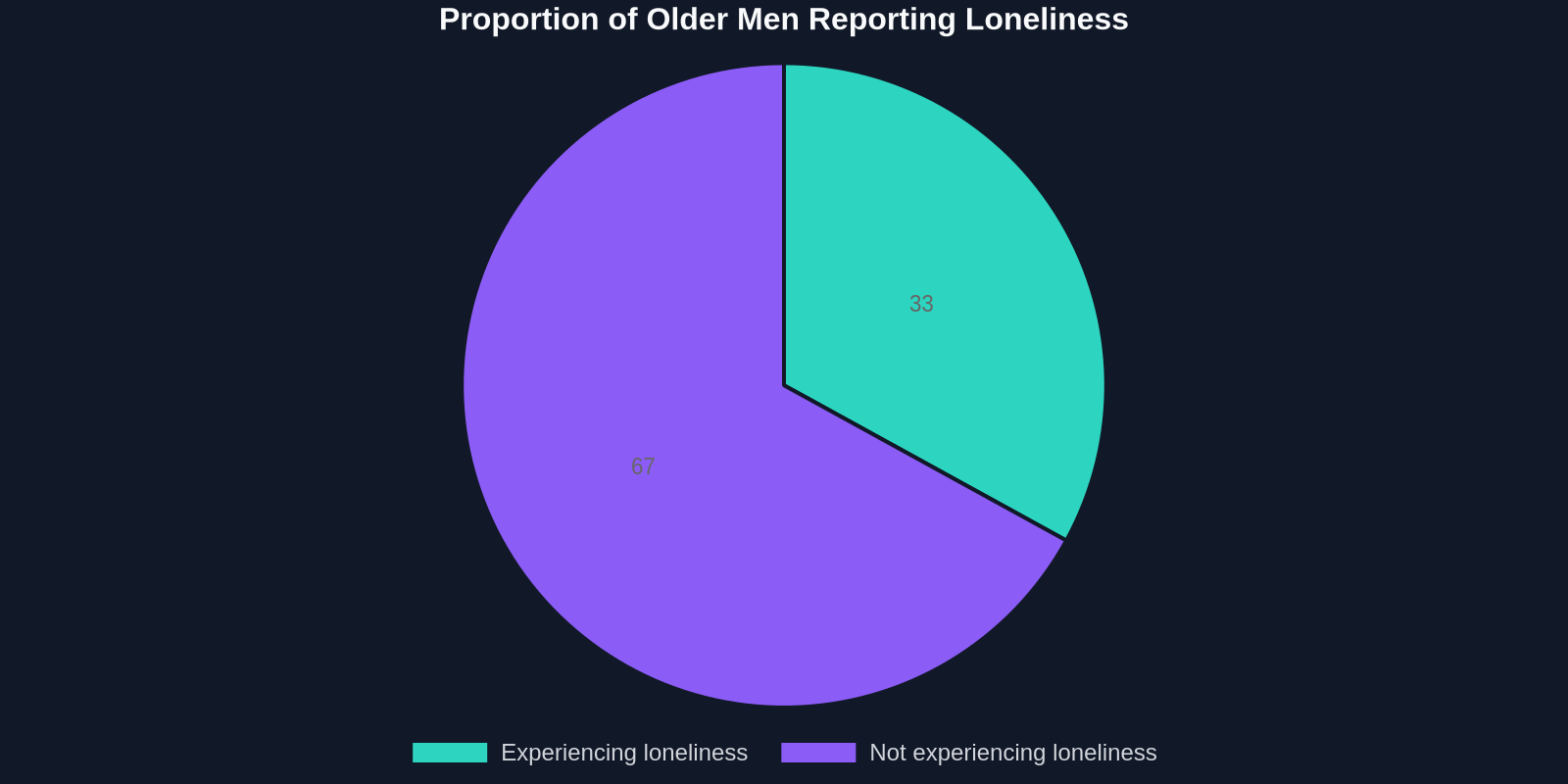
The loneliness epidemic is not a Kenyan problem alone. In high-income countries like the United States, the United Kingdom, and Australia, governments have appointed ministers of loneliness and poured billions into aging services because the phenomenon is so widespread. But the deepest answer is not a policy paper; it is a person, Christ, present through His body, the church. When an older man feels seen, known, and loved, the power of isolation breaks.
What This Means for Every Believer
You may not live in Kenya. You may not be a pastor or a mental health professional. But if you are a follower of Jesus, you are called to be a noticer. Notice the older man who used to sit three rows ahead of you and hasn't been in church for months. Notice the neighbor whose spouse died and whose garage door never opens anymore. Notice your own father, uncle, or grandfather, and ask him how he is really doing, not with a passing greeting, but with time and tea and a willingness to hear the answer that isn't "fine."
This protective effect is not magical. It is the natural outcome of being reminded that you belong to God and to a people. The church is the original support group, a family that doesn't dissolve when the paycheck stops or the diagnosis comes. When we take seriously the command to bear one another's burdens, we fulfill the law of Christ (Galatians 6:2).
"Bear ye one another's burdens, and so fulfil the law of Christ." , Galatians 6:2 (KJV)
For the busy believer whose days are packed with work, parenting, and the relentless demands of modern life, the call to elder care can feel like one more impossible expectation. But it often starts with something as small as a five-minute phone call, a handwritten note, or an invitation to lunch after the Sunday service. These tiny threads, when repeated, weave a net strong enough to catch a falling man.
A Reflection for Your Week
This week, consider taking one small step: identify one older man in your life or your congregation who may be isolated. If you don't know who that is, ask your pastor or a small group leader. Then make contact, a visit, a call, a card. Ask him about his story, not to fix anything, but simply to honor the image of God in him. And if you are the older man reading this, please know: you are not forgotten. The Lord sees you. He has not finished His work in you. As the psalmist wrote, "Now also when I am old and grayheaded, O God, forsake me not; until I have shewed thy strength unto this generation, and thy power to every one that is to come" (Psalm 71:18). Your testimony still matters.

God's economy never discards anyone. The saints we tend to overlook are often the very ones He has positioned to speak a word of life to the next generation. When we honor the aged, we are not doing a favor; we are making space for a gift the whole body needs.
As Kenyan churches are discovering, the revival of hope among older men often begins with the simple decision to show up. And as believers everywhere, we can let that decision shape our ordinary days. For those who want to keep Scripture woven into the fabric of daily life, a tool like Vesper offers one daily KJV verse right on your Lock Screen, a quiet reminder that God's Word speaks into every season, including old age.
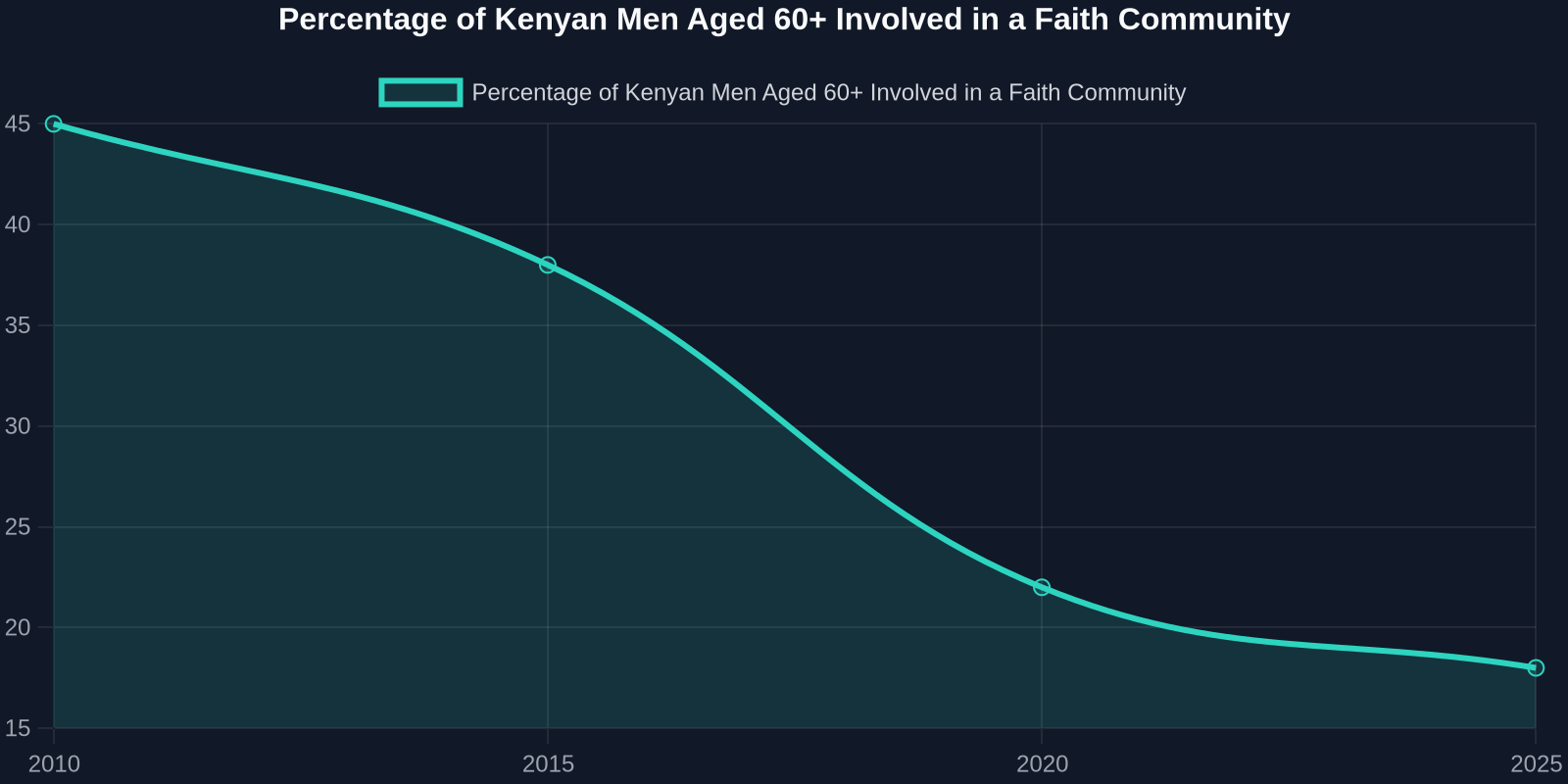
This final chart imagines a trajectory that, by God's grace, is already becoming visible in communities of faith across Kenya: as churches intentionally reach out to older men, the percentage of men engaged in spiritual community climbs. It is not yet the reality everywhere, but it is the promise of what the church can be, a household where no father is left behind.
Conclusion: Salt and Light for a Graying World
The story of Kenyan churches combating abandonment and suicide among older men is not just a news item; it is a living parable. It demonstrates what happens when the body of Christ refuses to accept the world's narrative of obsolescence and instead leans into the biblical call to honor, protect, and cherish the aged. In a culture that celebrates youth and speed, the church has a countercultural opportunity: to become a community where every gray head is a crown of glory (Proverbs 16:31). That transformation starts with a knock on a door, a shared cup of chai, and a heart willing to listen.
That number is more than a statistic; it is proof that the church can be a literal lifeline. As you go about your week, carry this story with you. Let it prompt a prayer, a phone call, or a visit. In doing so, you participate in the very heart of God, who promises to be near to the brokenhearted and to lift up those who are bowed down. The older men in your midst are not a project; they are your brothers, your fathers, your fellow heirs of grace. And the God who numbers the hairs on their head has not forgotten them, nor should we.